Blog Archive

Saturday, June 11, 2022

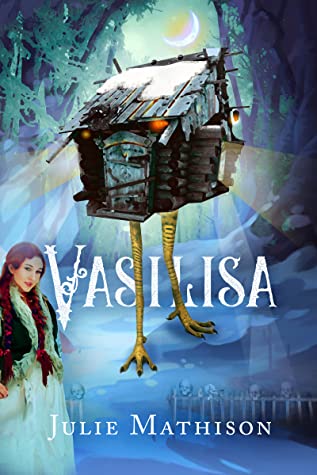
Vasilisa by Julie Mathison - Book Review

Vasilisa by Julie Mathison

Series: Old Rus (Book 1)

Genre: Middle Grade, Fairytale Retelling, Historical Fantasy 

4.3 Stars 

One Liner: Slow start but engrossing and beautiful 


*****

Edenfall, Pennsylvania, 1919:

The Great War may be over, but its aftermath continues to affect people. Vasilisa’s father is presumed dead, and her mother is being pursued by an orge. Babka, her grandmother, assures her everything will be fine. But Vasilisa knows she needs to do something fast. The events appear beyond Babka’s control. 

Ivan arrives in Edenfall with a task at hand. When Vasilisa’s and Ivan’s paths collide, they realize what they have to do. Baba Yaga and Koschei are right in the middle of the mess, and The Old Tales are the only way to set things right. 

Vassy and Ivan need to take up their roles and rewrite The Old Tales. Good has to triumph over evil once more. But how hard will it be for these two young kids? 

My Observations: 

The book begins at a languid pace with the right amount of foreshadowing. As the story progresses, we see character development and world-building in parallel. The imagery is lovely. 

Vasilisa’s character comes out alive on the pages. She’s such a delight to read. Ivan complements her character very well, bringing out both sides at the appropriate times. 

Since the story is the retelling of the famous Russian folklore, the book leans heavily on it. This can be a little hard if you have no idea about Russian lore. I knew bits and pieces, so managed without looking up the characters when reading. 

The book deals with many topics like kindness, bravery, forgiveness, acceptance, compassion, and a few more. It is a layered book but doesn’t feel heavy or overwhelming. 

I loved the scenes where the characters show their vulnerability while trying to become a better version of themselves. 

Little Bruno is my absolute favorite! I’m not telling you who he is. ;) 

The book has a long ending, which felt a bit overdone. The intention is to lead book one to book two, but I’d have preferred some of it in book two rather than at the end of the first book.  

To sum up, Vasilisa is an adventurous and entertaining story of a young teen protecting her dear ones from mystical creatures. 

I received a complimentary copy from the author through Voracious Readers Only. 

Thursday, June 9, 2022

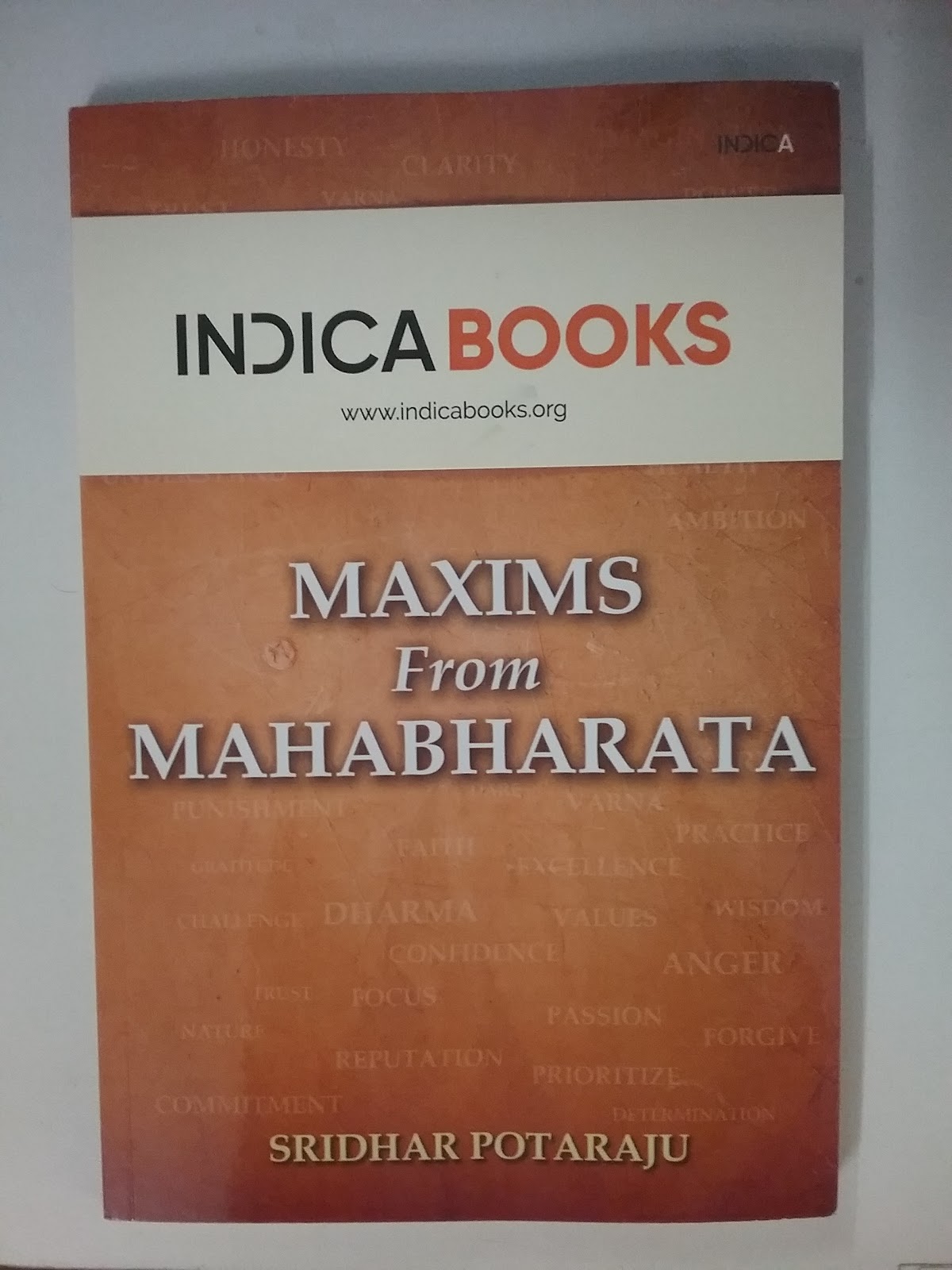
Maxims from Mahabharata by Sridhar Potaraju - Book Review

Maxims from Mahabharata by Sridhar Potaraju

Genre: Non Fiction, Indic 

3.5 Stars 

One Liner: Kudos to the intent and effort 


Maxims from Mahabharata is a compilation of Slokas from the epic, dealing with an array of important topics. The Slokas are originally written in Sanskrit. The author sourced them from the Devanagri script and translated them into English. He included the context, the name of the narrator, and the meaning of the Sloka. 

The book is short, crisp, and to the point. The author explains how he came up with the idea for the book and the amount of work required for the credibility of his translations. This book works more as a reference guide than a book one would read and keep on the bookshelf. 

Our rich cultural heritage has many pearls of wisdom scattered at random. Maxims from Mahabharata contains such Slokas to help people get a better understanding of their day-to-day lives. The topics are divided as: 

Dharma 

Truth 

Principles Governing Punishment 

Karma 

Hygiene as Good Conduct 

Nature 

Faith 

Anger 

Reputation 

Eternal Values 

Mental Health 

Power of Words 

The author is a lawyer, and it shows in his usage of certain words. In fact, a few meanings are written in the same long-winded sentences. The explanation of certain Slokas is too brief and doesn’t create much impact. 

Moreover, the English translation is written in Sanskrit/ Devanagri style, making the whole thing sound awkward. English sentences should have English grammar. A professional editor would have ironed out the bumps (this helps when reading focus majorly on English text). 

However, the book would work as a starting point for beginners trying to understand the intricacies of life, society, dharma, etc. Here are a few Slokas (meanings) I personally liked: 

"Wherever Krsna is, Dharma will be there, and where Dharma is, Victory shall be there." 

"A forest without lions is destroyed, and lions without forest will perish."

"If the earth is properly treated, it becomes father, mother, child, and heaven for all creatures."

"The man who incurs evil as the consequence of his own wrongdoings should not blame others for his own failings." 

"The daughter has been ordained to be equal to the son." 

"Mental stress leads to physical ailments, similar to how calm water tends to boil when in contact with hot metal." 

"As the destination of all rivers is the ocean, so the end of all embodied creatures is death." 

To sum up, Maxims from Mahabharata is the kind of book one could keep with them at all times and open a page when looking for affirmations or solace. 

I received a review copy from Indica Books and Indica. 

This review is posted as a part of the Thousand Reviewers Club. 

#ThousandReviewersClub 2022

Wednesday, June 8, 2022

The Seawomen by Chloe Timms - Book Review

The Seawomen by Chloe Timms

Publication Date: 14th June 2022

Genre: Dystopian, Women’s Fiction 

3.8 stars 

One Liner: The pacing is off but worth reading 

*****

Eden’s Isle has been Esta’s home forever. Being raised by her overly strict and God-fearing grandmother suffocated and scared Esta. She lost her parents and got scarred (on the face) in the same fire accident when Esta was three. 

She grew up fearing the seawomen and yearning to enter the water. Living on a small island with rules established for women to be virtuous and pious affected Esta in many ways. She witnesses the Untethering (women who cannot conceive are dropped back into the sea as a sacrifice).

Years pass, and Esta is married to a man decided by the Elders. Her motheryear has been decided by the Eldermothers. Can Esta conceive before the time is up, or will she be sacrificed to the sea? Is there any hope for the women on the tiny island who have to act according to the rules of the Elders? 

The story comes from Esta in the first-person POV. 

My Observations: 

The setting of the cult island is as dark and depressing as the theme. Get into the book with the right expectations to feel the oppressive mood of the island. 

The shift/ progress in Esta’s thoughts from her childhood to pre-teens to teenage is done well. However, she sounds the same at all ages. And she continues to sound more like a guest than a resident. Not to mention, she’s also more self-aware than other characters in the book. 

The characterization of Sarl (Esta’s grandmother) and Father Jossops was spot on. Their presence was a constant thing in the book. Sometimes, I felt these two outshone Esta in characterization. 

The tone is almost distanced and gets a little monotonous in the middle. It’s more like Esta is explaining things to the reader. The slow pacing doesn’t help either. Things start to happen after 75%. 

There’s a bit of fantasy (if you can call it that) but nothing spectacular. This works for the story as it kings things rooted in reality. 

The theme isn’t that unique per se (witch trials, abuse by church heads, oppression of women, etc.). However, that doesn’t take anything away from the book. I won’t compare it with The Handmaid’s Tale because I haven’t read it yet (don’t judge me). 

This book belongs to Esta. It doesn’t belong to the island or anyone else. The setting has been created for her, which means the closure comes only for Esta. There is no blanket ending. 

The writing has a very YA feel to it until towards the end. This should work for older teens who don’t mind reading depressing and dark subjects. 

Since this is a dystopian setting, suspension of belief is necessary. Some things seem farfetched, but the story demands them to be that way. Take it in stride. 

The ending is the highlight of the book. I would’ve loved an epilogue, though. The Untethering chapter acts as a prologue, so it’s only fair to have an epilogue. 

My major grouse with the book is the lack of mermaids. The entire plot is hinged on the seawomen, and we hardly get to see one. The tiny instances don’t count. I think I wanted more from the book, which left me a little dissatisfied.  

To sum up, The Seawomen is a slow-paced dystopian drama with powerful evil characters. Looking forward to more releases by the author. 

Thank you, NetGalley and Hodder & Stoughton, for the eARC.  

#NetGalley #TheSeawomen 

Sunday, June 5, 2022

Four Ways to Wear a Dress by Gillian Libby - Book Review

Four Ways to Wear a Dress by Gillian Libby

Publication Date: 07th June 2022

Genre: Contemporary Fiction, Romance 

2.8 Stars 

One Liner: More misses than hits! 


Mille Ward has been laid off from her PR job. She feels like a failure, not able to hold on to a job and settle down in life (according to her parents). Her parents blame it on her ADHD, but Millie knows that’s not the reason. She decides to visit her best friend Quincy in a small Bay town in California. 

Quincy and her folk of influencers work overtime to promote the laidback town, and Millie decides she could try a hand at becoming an influencer herself. Not to mention, she also gets to crush on Pete, Quincy’s brother, from close quarters. 

Her other two besties, Kate and Bree, help her with the move and encourage her to wear their magical black dress. It never failed them before, after all. Millie is doubtful she would fail the dress but wears it. 

When Millie has to convince Pete to be her Instagram Husband to promote her profile and his hotel business, things get a little complicated for them. Can their fake relationship lead to something real? Can the influencers save the town? Can Millie get her career back on track? 

The story is written in Mille’s first-person POV. 

What I Like: 

Millie is a decent character when she doesn’t go overboard (which happens more often during the second half). 

The setting was beautiful. I liked the scenes about surfing. Got to learn something from it, so that’s always a plus. Not that I intend to surf or anything. 

Pete is a really cool character (it also helps that he is super handsome). I feel bad for him, thanks to Millie’s stupidity. Not that he was faultless, but still. 

We see different types of working women, and each of them goes through ups and downs. I don't like Alana’s idea of perfection, but I can understand her fear of losing followers and risking everything they built from scratch. That doesn’t excuse her interference in others’ lives. 

The story has potential and made me chuckle a few times. I also didn’t have to stress my grey cells, which is another plus. But it could have been so much better. 

What Didn’t Work for Me: 

This is a case where the reader can see that Pete is in love with Millie, but she doesn’t see it (she is the narrator). She is determined to remind him that their relationship is fake at every possible opportunity. I started checking how many pages were left each time this happened. 

While the title makes the black dress a prominent part of the book, the storyline somehow loses track of it. There’s a scene towards the end that feels patchy and unnecessary (only to somehow do justice to the title). The book could’ve been the same even without that dress. Not to mention that the same dress fits four different women. 

Since when did an invitation to an interview imply a job? If that was the case, the unemployment rate around the world would never shoot up. Getting a job isn’t that easy. Millie getting kicked out of hers on the first page of the book is enough indication of the market conditions.

A major part of the book is about the life of social media influencers. It sure is damn hard to create an Instagram-worthy perfect life and hide the rest from the world. But that shouldn’t come at the cost of personal, especially kids’ future. 

Alana’s character is a contradiction throughout. I still don’t know who she really is.  

Millie is almost an instant success on Instagram. She has like 75K followers in around a month. How does that happen to non-celebs or people without no previous accounts or recognition on social media? (I’m a content writer, and digital marketing is one of my niches.) 

ADHD and autism are both a part of the book, but neither gets justice. And no, Millie can’t blame her stupidity on ADHD. I disliked how the kid (Quincy’s son) hardly got any space in the book. Nope. He deserved better. 

To sum up, Four Ways to Wear a Dress is a lighthearted book with some laughs and annoying moments if you don’t mind an overload of the influencer stuff. Oh, a generous amount of the F-word. 

Thank you, NetGalley and SOURCEBOOKS Casablanca, for the eARC. 

#NetGalley 

*****

P.S: The book has steam (level 3-ish, I suppose). Readers, be warned. ;) 

Saturday, June 4, 2022

Damage & Other Stories by Poornima Manco - Book Review

Damage & Other Stories by Poornima Manco

Genre: Short Stories

2.5 Stars 

One Liner: It could have been better 

*****

*Long Post Alert* 

*Contains Spoilers* 


*****

I picked up the book with some expectations. Having read two anthologies by the author, I was sure this would work. Sadly, it didn’t. Not because I’m not used to dark emotions. But because many stories don’t reach the mark, and one is subtly ideological. 

Damage: The first story in the book and one with great potential. Yet, it felt like too many themes crammed into a smaller word count. None of it seemed real or relatable. (I don’t move in such circles anyway.) And no full-page introspections, please. 

Samsara: If you are like me, let me inform you that Samsara is a perfume. The word also means family in Telugu (though it would be samsaram). An apt title, in a way. This is a sort of crime thriller with a female cop and the death of a politician’s wife. The plot had merit, but the narration didn’t have enough words. This story required a larger canvas. The female cop had such potential. A novel or a novella would do justice to her character. 

Creep: A creep trying to smooth talk women to get laid. A short piece from the creep’s POV. Does the job but not enough. 

Ma Vie Sans Couleur: I have no idea what happened here. There are too many themes (adultery, racism, mental illness, abuse) left hanging in the air, with faint threads connecting some of them. Too vague. 

Secrets and Lies: The dead grandfather still manages to protect the young grandson. But can the boy find love and affection from this arrangement? The POV keeps the story interesting, as the intentions of other characters are revealed in bits and pieces.  

The Consequence of Contradiction: This was a little confusing in the beginning. It settles down later and packs a punch. A very well-written tale that ends right where it should. One of the best in the book that will leave you thinking. 

The Unlikely Casanova: “Creep is so middle class, Monisha. It’s Casanova!” says Maya Sarabhai. Indians will understand the reference here. To explain, this story is an elite version of Creep we read a couple of stories earlier. 

Swami Claus: The internal darkness of self-declared religious leaders but with a twist. The double track is interesting and makes the storyline fresh. I initially thought it was about that pedophile Ram Rahim, but I’m not entirely sure. Children continue to suffer, be it in Asia, the Middle East, Europe, or America. 

Ugly: A story told in two POVs- the brute husband and a too-loyal wife. Sadly, this is a common occurrence in our society. The story starts with a bang, but the ending is melodramatic and OTT. It would have been more powerful if the ending was realistic.  

Palindrome: Is this inspired by Sridevi’s death? Maybe, maybe not. But an Indian reader cannot help but wonder. The title suits the story- the rise and fall of a famous actress in the film industry. It tends to lag at times but wraps up well. 

Dear Anil: A letter from a woman to the only love of her life. She details the journey from childhood friendship to unrequited love to a relationship that probably wasn’t meant to be. A sad story indeed.  

Unrequited: A semi-erotica presented as a feminist revenge story. It wasn't bad though. 

The Strings That Bind Us: This was bittersweet in its own way. It seemed like the author wanted to use the same story for multiple themes (friendship between cousins, family dynamics, and children neglecting parents). It works because of the two lead characters. 

Fallen: This is Raavan’s POV of Ramayana, and honestly, he deserved a better voice. Raavan has always been a huge (larger-than-life) presence. You are sure to find intense drama when Raavan is around. This version is mild and almost resigned. I don’t remember reading Raavan being this mild, even on his deathbed. And no, I didn’t mind the sly digs at Rama. Those are expected when the story is from Raavan’s POV, but I wish the tone was powerful enough to establish his voice.  Gimme the attitude!

Like a Boss: Okay! This is a sort-of retelling of the Nirbhaya case that shook India years ago. I’m not sure how I feel about this but the writing is impactful. So that’s something. 

The dead girl’s parents had to fight for so many years to get justice for the dead child. Incomplete justice because one of the rapists (a juvenile from the minority community) was released within three years. He was gifted a sewing machine, Rs. 10,000/-, and a new identity away from the public eye. 

Imagine that! A teen old enough to rape someone is being protected and safeguarded even today. What’s worse is that his counselor says there is no change in him. No remorse, nothing. He should have been tried as an adult and hanged with the others, but no. Let’s protect and unleash him on unsuspecting people! 

Love Jihad: This story comes right in the middle of the book but I decided to wait until the end to read this. A good decision, indeed. You’ll know why soon enough. 

This dual plotline has two couples- one in London and another in Jaipur, India. Both tracks have a Hindu girl falling in love with a Muslim man (the eternally romantic love story), but with different endings. The London track has educated and ‘liberal’ families, while the Jaipur track deals with the poor. 

On the surface, it appears perfect, with two contrasting endings that show two sides of the story. But is it really unbiased? Let’s analyze the execution and find out. 

London Track- The guy is handsome, so handsome that every woman (married and unmarried) in the heroine’s office wants nothing more than to screw him. Should I feel pity for objectifying the guy, or should I be worried that the trope matches the H-M porn sold on Amazon

The girl gets pregnant and marries her lover. Then, we get to know she may not be treated well and may have been forced to covert. Nothing is explicit in the narration. It’s all between the lines and gut feeling. When the girl’s family and a friend try to get her back home, they find out that the guy’s family has left the city.

Jaipur, India Track- This is where the author’s intelligence comes out in full force. The H girl and M guy are high school kids from a poor background. The girl’s brother (wait for it) goes around campaigning for a saffron-robed Guruji who ‘spreads venom against Muslims’. The author takes great pain to show the ‘hatred’ and ‘bias’ in explicit detail. After all, how else will the reader know that they are reading about Hinduvadis? 

The girl’s possibly uneducated mother speaks more like an upper-class woman about her ‘Hinduvadi son’ and the ‘hate-monger Guruji’. Finally, the story ends with the girl’s brother burning her M boyfriend and posting the video on Twitter. He is a ‘maniac’ Hindu burning a Muslim boy for daring to love his sister. We have almost no information about the clothes the characters wear in the story. But we most certainly know that the Guruji wears saffron. Such detailing! 

Now, let’s shift the scene to real life and look at a few reports from recent times. Mind you, these are limited to the guys who were murdered. Don’t even get me started on the cases about women who were abused, raped, kidnapped, converted, butchered, and packed into suitcases. I’ve been following the reports for more than five years. I know exactly what I'm talking about. 

Mithun Thakur was killed by his M girlfriend’s family. 

Vijaya Kamble (25), a Dalit, was killed by the family of his Muslim girlfriend in Bangalore. 

Nagaraju, a Dalit boy, was killed by his M wife’s brothers for the inter-faith marriage. The girl repeatedly blamed her mother and brothers for the murder (there was already a case registered in the police station seeking protection from them). She chose to live with her dead husband’s family. The media, of course, wants you to believe that the upper caste Hindus are somehow responsible for it when they are not even involved in the first place. 

Dablu Singh (22), Sanjay Kumar, Rahul (20), Ankit Saxena, and Ravi (17) are just a few names where Hindu boys have been murdered for falling in love with Muslim girls. 

This 14-year-old boy from the Schedule Tribe community was butchered because the boy spoke to a Muslim girl. 

But then, who is to blame in fiction? The Hindu fanatic brother, of course! 

Let me make one thing very clear. I am under no stupid illusion that Hindus don’t kill or commit crimes. I would have had no problem with the story if the girl’s brother was a maniac by default. He could have been a wastrel who couldn’t digest his sister loving a boy from another religion. He could have been anything, literally, and the storyline would still hold strong. 

What I object to is the blatant ideological thrust on readers by describing the guru and his activities while only hinting at what could have happened in the other track. Why not show them both the same way? Why go into detail about Guruji but not Mohsin and his parents? 

I’m reminded of the intellectual’s idea of a good Hindu. A good Hindu is someone who bends backward to appease others but has zero self-respect. This good Hindu, with a minus-level understanding of Hinduism, mocks their own culture and relates to a foreign culture. 

Do you know who a bad Hindu is? A bad Hindu doesn’t appease others and is proud of their rich cultural heritage. A bad Hindu asks for equal rights and takes a firm stand, declaring that respect is a two-way street. The story pretty much pushes the idea of a good Hindu to the readers. Too bad I am not one of them. 

I’ve read Eight - Fantastical Tales From Here, There & Everywhere and Holi Moly! & other stories by the author and enjoyed the stories. This one, however, is an exception. 

The book feels like it has been written for people who are not comfortable with dark stories but want to try if they can handle grim and disturbing. The themes are hinted at, but there’s nothing graphic or detailed in some stories. This makes the Indian track of the Love Jihad story rather apparent. 

To sum up, Damage & Other Stories could have been an outstanding collection if some stories were more fleshed out and personal ideologies were kept away from sensitive topics. 

I should have rounded it off to 3 stars (which would be more accurate considering the stories), but I can’t make myself do that. So 2 stars it is. 
Thursday, June 2, 2022

Can't Look Away by Carola Lovering - Book Review

Can't Look Away by Carola Lovering

Publication Date: 14th June 2022

Genre: Contemporary Women, Drama 

2 Stars 

One Liner: Duh! 

*****


2013: Molly, a 23-year-old MFA student, and Jake Danner, the lead singer and guitarist of the Danner Lane band, meet and fall in love. Their relationship is intense, draining, and explosive, with the two of them wanting forever. 

A Decade Later: Molly is married to Hunter and has a six-year-old daughter Stella. She and Hunter are trying for another child through embryo transplantation. Molly is lonely and unable to fit into the wealthy lifestyle of Flynn Cove. 

She meets Sabrina, who seems to be just like her. The two hit off instantly and become good friends. As Sabrina spins her web, Molly can’t help but feel torn between her past and present. Sabrina won’t stop until she gets what she wants. 

Can Molly deal with the aftermath? What will her past cost her? 

My Observations: 

  • First 33% - Not sure if I was too tired or bored to not care about the characters 
  • Next 33% - Hmm… can the plot move ahead, please  
  • Last 33% - At least, it’s over 

The story comes in installments of past and present from Molly and Jake's limited third-person POVs and Sabrina’s first-person POV. 

There’s a lot of story (info dump) despite the segregation of the plot into different segments. Sabrina’s present chapters were interesting of all. 

Sadly, none of the characters made me feel anything for them. Not even dislike. I didn’t care for any of them for the majority of the book. Stella was the bright spot whenever she appeared. 

There’s so much drama, but it felt so distanced that I was bored rather than feeling sad for either character. The writing is too much YA-ish, but I enjoyed some YA books way better than one. 

And no! This is NOT a thriller. It is a drama. I didn’t find anything remotely ‘thrilling’ in the book. The twists can’t even be called twists, IMO. 

It’s kind of ironic that the book has scenes about multiple edits required to polish and fine-tune a manuscript. If only… 

I can’t say who the right audiences for the book are, but it’s not me. I was bored more than half the time. (I'm repeating myself. Can't help it). 

The pacing is super slow. I finished it in 3 days only because I started to speed-read from the first day. No way I would spend more than 3 days on a 320-page book that claims to be a thriller. 

To sum up, Can’t Look Away is a drama that reads a lot like a YA book with NA characters. However, read other reviews before you decide. 

Thank you, NetGalley and St.Martin’s Press, for the eARC. 

#NetGalley