Blog Archive

Showing posts with label Indic Book Club. Show all posts

Tuesday, February 28, 2023

Devi For Millennials by Bibek Debroy - Book Review

Publication Date: 5th Oct 2022

Genre: Non-Fiction, Spiritual, Hinduism 

4.5 Stars 

One Liner: The first step to understanding Devi (meant for young readers)


It’s hard to review a book like this one. Devi for Millennials is exactly what the title says. It is a book about Devi for contemporary readers with little or no knowledge about Hindu scriptures. It deals with the history of Devi worship in Puranas and Devi Gita. It also has slokas from tantra worship.

The book simplifies the content without diluting its essence. The author clearly states that the translations of the Samskritam slokas are his interpretations. Though the language is simple, it has a soft melody that makes the translations sound beautiful in some places. There are clear tables that describe how Devi was formed (which parts belonged to which devas) and the Shakti Peethas. 

The author also provides interesting insights into language and its limitations. For example, Durgaa is feminine, but Durga is masculine. Imagine how difficult it would have to correctly translate the slokas into other languages without confusing the gender dynamics. 

Small stories from the Puranas are also shared to provide the backstory or context for different avatars of Devi. The book is divided into neat sections, with some information and explanation, followed by the translations of a selected few stanzas from the suktams and stotrams. (There is also a short explanation of the difference between the two). 

The book deals with Sati Kanda from Shiva Purana and lists the 108 Shakti Peethas mentioned in various texts. The author also highlights the variations in the texts and how some of them tend to contradict each other. However, the bottom line remains the same- the places mentioned have a strong history of Devi worship. 

An entire chapter explains Navaratri, the pooja, and the nava durgaas worshipped during this period. He describes the avatar of each durgaa while emphasizing the importance of iconography. The topic is not explored in detail but provides enough material to get a basic idea. 

The next chapter deals with the thousand names of Devi mentioned in Lalitaa Sharasranama and ends with three versions of how Sankaracharya composed Soundaryalahari. The final section is dedicated to Devi Gita. Here, the author reminds us that he has merely translated the slokas and not interpreted them. 

There is a recurring mention of nature’s elements (fire, water, air, earth, and spirit) and their role in Devi worship. There are also references to triple elements (we can find parallels with other pagan cultures that worship triple goddesses in different forms). In fact, the yantra designs are similar to the symbolism in ancient pagan cultures (the triangle being the most prominent and common symbol). However, don’t expect a detailed analysis of symbols in this book. This work is the first step to understanding Devi and becoming comfortable with her iconography. 

To summarize, Devi for Millennials isn’t a book we display on the shelf or read and move on. It is to be treasured and referred to each time you want to know about Devi and her presence in this universe. 

I won a copy of the book in the giveaway contest organized by Indica. 

#IndicReads 

Saturday, August 20, 2022

Giant Genius Bhyrappa and Mirrors of His Novels by M.S. Vijaya Haran - Book Review

Giant Genius Bhyrappa and Mirrors of His Novels by M.S. Vijaya Haran

Genre: Non-Fiction

4.5 Stars 

One Liner: A comprehensive compilation; a must-read for Bhyrappa fans  


The book is a collection of memories and experiences of various translators who worked with Bhyrappa and translated his works into a multitude of languages. Creating a book like this is no small feat when we consider the extent of translations- the languages, the reprints, and the varied medium in which the great man’s works were presented. Giant Genius Bhyrappa and Mirrors of His Novels is a result of the tremendous hard work of M.S. Vijaya Haran, a senior broadcaster and researcher. 

M.S. Vijay Haran is the Station Director of AIR Mysore and has decades of experience in the field. Reading her detailed note at the beginning of the book gave me a clear picture of the effort and love that went into bringing this book to life. The editor released a book titled Namma Bhyrappanavaru in Kannada in 2020. This book can be considered the second part or an extension, albeit in English. 

Bhyrappa’s books were translated into many regional Indian languages, along with Samskritam, Chinese, and Russian. A total of seven novels were translated into Samskritam- Sartha, Daatu, Dharmashree, Aavarana, Vamshavriksha, Tabbaliyu, and Parva. Parva was translated into Chinese and Russian. Then we have his books in Telugu, Gujarati, Hindi, Malayalam, Tamil, etc. 

The book is divided into six parts: 

  • Part I is about Bhyrappa 
  • Part II is about various translators who worked with him
  • Part III is about translators who are no longer in the mortal world 
  • Part IV is about audiovisual and theatrical adaptations of his works 
  • Part V is about adaptations by people no more alive 
  • Part VI about the comments from the press 

For someone who read just one book by the literary genius (and the other English translations on the TBR list), reading this compilation has been a treat. I was unsure whether I could read it from start to finish and not end up with spoilers for his works. Yet, I wanted to read it all and know more. I had to skim through a few pieces as the translators went into detail about the stories and characters from the books they translated. 

The translator’s experiences came straight from the people themselves (or their dear ones in the case of the departed souls). Each piece started with the translator’s picture and ended with their bio (icing on the cake). 

Part I and Bhyrappa 

The first part has three write-ups, two by those who know Bhyrappa and one by the man himself. This gives us a glimpse into his childhood, the hardships he faced, and his subsequent growth as a person and a writer. It’s not detailed but just enough for the reader to connect with Bhyrappa. I love how he spoke about his writing process; how disciplined, systematic, and planned his approach is. Armed with this information (including the editor’s note and foreword), I delved into the experiences of various translators and their associations with Bhyrappa’s works. 

Bhyrappa- The Human  

Reading about the translators’ experiences gave me more insights into the great man. He is humble and warm yet a bit introverted and likes his own space. More than one translator spoke about how he was ready to provide financial help and even enquired if the publishers were paying their fees per the contract. He didn’t accept the royalties for the Samskritam translations of his books as he considered it his contribution to promoting the language. 

I so wish I could meet him one day! 


Translations- Urdu, Chinese, and Russian 

The Urdu translation of Vamshavirkha was done by Prof. Syed Shahabuddin (fondly known as Roshan). He recounted how difficult the entire process was, right from the lack of a dictionary to bridge the gap between the languages (he created one himself) to publishing the book on his own with almost no funds. His determination and efforts bore fruit (in many ways). 

The Chinese and Russian of Parva were ordered by the Indian government (PM Modi) in 2020 (it was one of the ten classics selected). The translators spoke about how they had to work on a tight deadline during the lockdown and how Parva influenced them. I enjoyed reading Ms. Xu Ke’s experiences and comparisons between the two ancient cultures (Bharat and China). 

Vamshavrikha in Telugu 

How can I not talk about the screen adaption of Vamshavriksha? I confess I haven’t watched the movie in full but intend to do it as soon as possible. The movie was released in 1980 by none other than the late Bapu (director) and Ramana (script and dialogue writer) duo. 

Source: Wikipedia
My father told me that they interacted with Bhyrappa to make a few changes to the plot to suit the Telugu audience. The movie had Anil Kapoor as one of the main characters (before he went on to become famous in Bwood). 

But what makes the movie special even today is Bhyrappa’s story, Mullapudi Venkata Ramana’s dialogues, Bapu’s directorial mastery, and JV Somayajulu and Jyothi (the two main characters). I remember watching a couple of scenes (the climax and ending) on TV and noticing tears streaming down my father’s face (he watched the movie multiple times by then). 

That’s what a solid story does to you. It breaks your heart and pieces it back together every single time. 

Vamshavriksha was also one of the first Bhyrappa's books translated into Telugu (before the movie was made). 

Subbu Publications 

It would be unfair if I didn’t mention Subbu Publications in my review. This is a huge book with 578 pages. The font size and print are great. Big enough to read (even for seniors) and neatly spaced text throughout. It’s a relief to read books with a font size that doesn’t resemble ants or even their babies!

The Last Word

Before I conclude, I’d like to share this article with you. Written/ translated by Sandeep Balakrishna, it gives us a tiny glimpse of what Bhyrappa had to face from the self-proclaimed champions of (FoS & FoE) Freedom of Speech and Expression. Bhyrappa has detailed the same in his autobiography, Bitti. 

To summarize, Giant Genius Bhyrappa and Mirrors of His Novels is a tribute to the literary genius and a wonderful way to know more about the man behind many successful novels. He is Bharat’s treasure indeed. 

I received a review copy from Indica Books in exchange for an honest review. This review is posted as a part of the Thousand Reviewers Club. 

*****

P.S: I am delighted to post my review on his birthday. Happy Birthday, Bhyrappa garu! 

Thursday, June 9, 2022

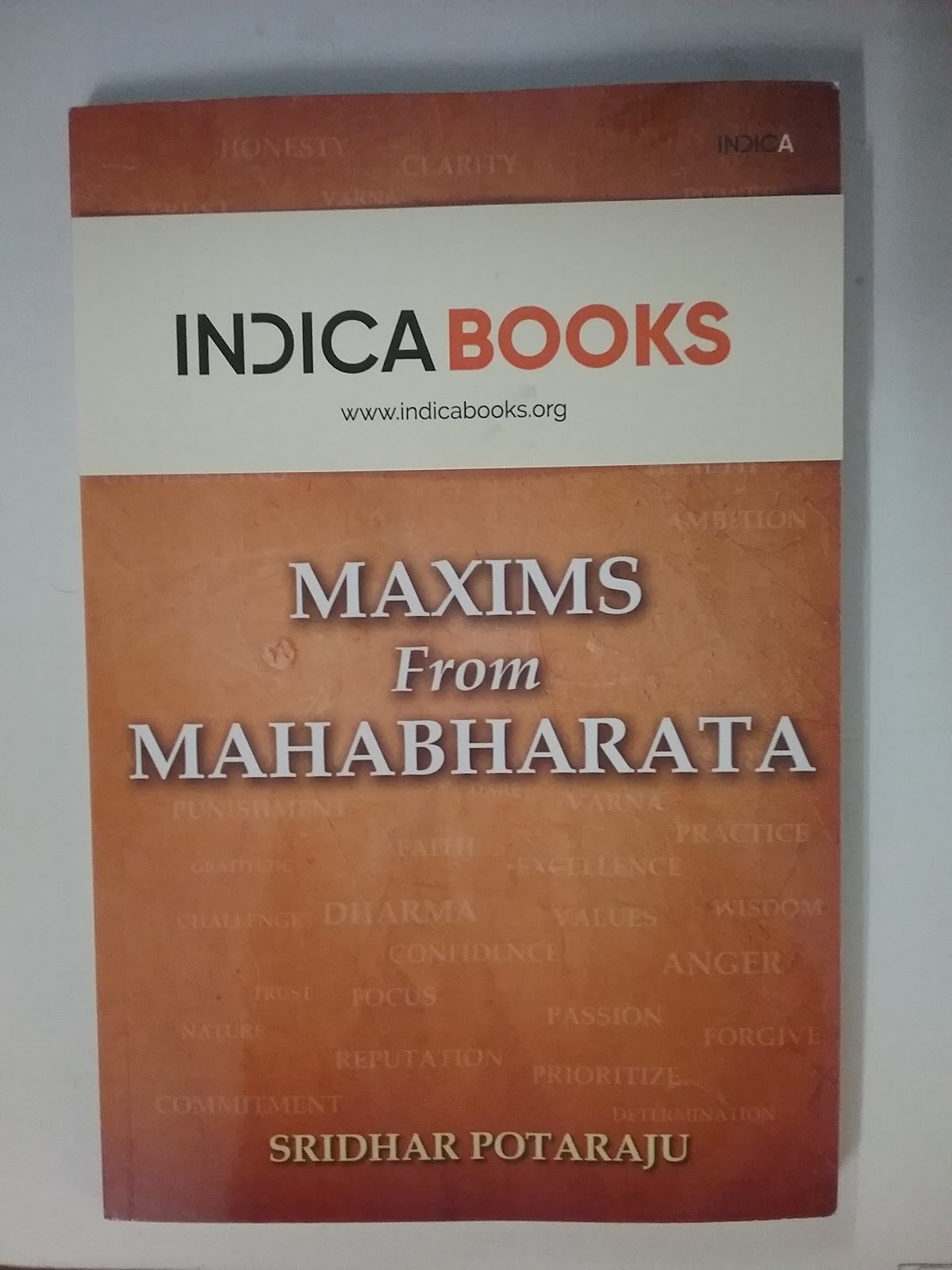
Maxims from Mahabharata by Sridhar Potaraju - Book Review

Maxims from Mahabharata by Sridhar Potaraju

Genre: Non Fiction, Indic 

3.5 Stars 

One Liner: Kudos to the intent and effort 


Maxims from Mahabharata is a compilation of Slokas from the epic, dealing with an array of important topics. The Slokas are originally written in Sanskrit. The author sourced them from the Devanagri script and translated them into English. He included the context, the name of the narrator, and the meaning of the Sloka. 

The book is short, crisp, and to the point. The author explains how he came up with the idea for the book and the amount of work required for the credibility of his translations. This book works more as a reference guide than a book one would read and keep on the bookshelf. 

Our rich cultural heritage has many pearls of wisdom scattered at random. Maxims from Mahabharata contains such Slokas to help people get a better understanding of their day-to-day lives. The topics are divided as: 

• Dharma 

• Truth 

• Principles Governing Punishment 

• Karma 

• Hygiene as Good Conduct 

• Nature 

• Faith 

• Anger 

• Reputation 

• Eternal Values 

• Mental Health 

• Power of Words 

The author is a lawyer, and it shows in his usage of certain words. In fact, a few meanings are written in the same long-winded sentences. The explanation of certain Slokas is too brief and doesn’t create much impact. 

Moreover, the English translation is written in Sanskrit/ Devanagri style, making the whole thing sound awkward. English sentences should have English grammar. A professional editor would have ironed out the bumps (this helps when reading focus majorly on English text). 

However, the book would work as a starting point for beginners trying to understand the intricacies of life, society, dharma, etc. Here are a few Slokas (meanings) I personally liked: 

"Wherever Krsna is, Dharma will be there, and where Dharma is, Victory shall be there." 

"A forest without lions is destroyed, and lions without forest will perish."

"If the earth is properly treated, it becomes father, mother, child, and heaven for all creatures."

"The man who incurs evil as the consequence of his own wrongdoings should not blame others for his own failings." 

"The daughter has been ordained to be equal to the son." 

"Mental stress leads to physical ailments, similar to how calm water tends to boil when in contact with hot metal." 

"As the destination of all rivers is the ocean, so the end of all embodied creatures is death." 

To sum up, Maxims from Mahabharata is the kind of book one could keep with them at all times and open a page when looking for affirmations or solace. 

I received a review copy from Indica Books and Indica. 

This review is posted as a part of the Thousand Reviewers Club. 

#ThousandReviewersClub 2022

Sunday, April 10, 2022

Veer Savarkar by Uday Mahurkar & Chirayu Pandit - Book Review

Veer Savarkar: The Man Who Could Have Prevented Partition by Uday Mahurkar, Chirayu Pandit

Genre: Non-Fiction, Indian Politics 

4.5 Stars 

One Liner: Informative and easy to read. 

*****

Veer Savarkar has been a controversial personality in India for many decades. While the left cabal hates him, the non-left looks up to his values, and there are enough people on the fence who don’t know what to believe. 

The partition of India and Pakistan has for long been a gut-wrenching topic. The generational trauma of the survivors of the partition and the subsequent Kashmir genocide (along with the Moplah massacre, the Direct Action Day) are hard to forget, no matter how many intellectuals want to brush them under the carpet. 

This book focuses on the events leading to the partition and how Savarkar came close to preventing it from happening. The book isn’t an emotional appeal or an intense read. It has an easy conversational writing style and presents facts with relevant proofs and footnotes. 

The book debunks various lies spread about Savarkar and presents the aspects that were hidden from being common knowledge. Do you know that Savarkar was a crusader for equal rights for everyone? He conducted camps to empower the so-called untouchables, organized inter-caste dinners and supported those who wanted to marry people from other castes. The only condition was that the marriage had to be for love and not forced or in the name of revenge. While Ambedkar got into the limelight (not without reason), Savarkar was conveniently pushed into the dark. 

Savarkar was emphatic about equal rights, which meant he was dead against the appeasement politics by Congress. Nothing much has changed over the years. In fact, things have gone from bad to worse. 

The role of Congress in partition, oh, well! The party has always been a bunch of narrow-minded, visionless politicians (except for a few noteworthy leaders) who never really related to reality, even if it hit them in the face. 

When you read the predictions Savarkar made, you realize just how right he was. The book shows his visionary side, and I couldn’t help but admire his grasp of human psychology and the inherent differences in the thought processes of different communities. 

The partition has been a psychological game, a manipulation of masses at its very best, which continues even today. Imagine a 500%+ explosion of the population of a community in one country and still the claims of being a victim. The platinum victim card was first invoked in the late 1800s, revived during the early to mid-1900s, and is still continuing even today.

What’s crucial to recognize here is that the ones who are hardworking rarely call themselves a victim. It’s almost always the ones with privileges that think they are entitled to special treatment. The sad truth is that we hardly know of the great Muslim leaders who truly worked for the nation rather than for religious dominance. Many of them fought lone battles, ousted by their own people. Those are the men (& women) we need to know about (the book mentions a few of them, and I couldn’t remember reading about any of them earlier). 

Another (not-so) surprising aspect is that the two-nation theory was first proposed by Syed Ahmed Khan in the 1830s something and promoted by Jinnah. But the blame falls on Savarkar, who wanted to keep the country united. (And no, I didn’t get to know of this after reading the book. I found out about this around 4-5 years ago.) 

I have to add a point that my heart stopped when I read that the great Mahatma thought there was no need to have an army for India after the partition. He didn’t want Indians to defend themselves from their ‘brothers’. Given the number of attacks we faced during the last 7.5 decades, this one statement was enough to show his inability to see the truth for what it is. Thank God, good sense prevailed in some of the then Congressmen who rejected his words. 

I could write a lot more, but will instead leave you with a couple of quotes from the book. 

Dr. Mukund Ramrao Jayakar said, ‘The word communalism has acquired a most extraordinary significance these days [even before the partition]. If I venture to speak for Hindu rights, I am a communalist, but if a Muslim with nationalist tendencies fights for Muslim rights, he still remains a nationalist.’ [This was about Jinnah.]

If nationalism means that the Hindus should cease to be Hindus, even culturally, racially, or religiously, while all other non-Hindu Indians despise to adopt that attitude in their own cases, then such a nationalism is the most criminal and dastardly betrayal of our true national soul and ancestral heritage.

Any nation who helps India or is friendly towards her struggle for freedom is our friend and the nation which opposes us or presents a policy inimical to us is our foe. 

I respect his ability to see patterns by stripping away the disguises with such ease. How clear and precise his opinions were! Sure, he was far from perfect; but who is flawless? 

The book has some repetitions and quite a few references to the current government (which might actually dilute the purpose of the book). However, it presents the partition from a broader perspective with emphasis on the political and personal ambitions/ ideologies of a handful of men who successfully messed up millions of lives for their benefit. 

I received a review copy from Indica Books in exchange for an honest review. All opinions expressed are my own.

This review is posted as a part of the Thousand Reviewers Club 2022, an initiative by Indica and Indica Books. 

*****

PS: I haven’t yet read any other books about Savarkar, and this is my first major reading. 

Friday, August 6, 2021

12 Rules for Life: An Antidote to Chaos- Book Review

12 Rules for Life: An Antidote to Chaos by Jordan B. Peterson

Genre: Non-Fiction, Self-help

3.3 Stars 


Disclaimer: I am not the target audience for the book. I’ve read it because it was sent to me by the review club. I’ve never been a fan of self-help books, and my opinion remains unchanged. 

***

12 Rules for Life offers just what it claims in the title and much more. The author is a professor of psychology and a clinical psychologist. He mentions how the idea of writing the book (by compiling his answers on Quora) came when a literary agent suggested it. 

The book is more than 400 pages long with 200+ footnotes and not to mention a bundle of references at the end. The author deals with each rule in detail. There are frequent references to Bible, religion, and at times, other religions. 

He also talks about animals, evolution, human nature (obviously!), and situations from his life. I liked the dry humor in bits and pieces, though the overall tone (that’s exclusive to self-help books) bored me quite a bit. 

The rules I liked were the ones that deal with friends and kids. He uses his personal and professional experiences to explain, and that made them interesting. My personal opinions aside, I liked how he put across his ideas for these. 

The other two that caught my attention were about listening, being precise in speech (irony, I know), and not bothering kids when they are skateboarding. 

I did skim through some reviews on Goodreads when I received the book and saw that a few readers were triggered. Halfway through the book, I could see why. If only he emphasized more on it without leaning on Bible and the Testaments! It’s almost as if the first half and second half of the book don’t match. 

Maybe the book could have been made into three books- 

one to talk about the rules for life in a precise manner, 

one to compare religion and life at large, 

and the last book to analyze communism, socialism, and of course, trigger some of the crowd. 

Wouldn’t that have been a treat to read? Each book could be picked up by the respective target audience. 

I got pretty bored of the first half and would have DNF’d the book if it wasn’t a mandatory read. The second half is almost redeeming. But still, I’d rather read the next half directly without going through all of the previous stuff. 

Two quotes I loved from the book-

“Don’t hide baby monsters under the carpet.” 

“Because too agreeable people bend over backwards for other people, they do not stand up properly for themselves.”

He goes on to say how this attitude makes them resent others and the world at large for not understanding them and their sacrifices. Makes sense to me, more so because I’ve seen such people in real life. They drain your energy real quick! 

To sum up, I enjoyed the book better than what I expected when I started it. The book did give me a few points to think about, so that’s something for sure. The rating went from 2 to 3.3 stars for the same reason. 

People frowning and smirking at my review (rant) are likely to enjoy the book a lot more. Don’t listen to me to make your decision (as you would have already summarized). Go ahead and give it a shot. You might love it. Who knows! 

I received a review copy from Indic Academy and Indic Book Club. This review is posted as a part of the Thousand Reviewers Club. 

***

P.S: Can Penguin please use a larger print next time to save readers’ eyes?

Saturday, June 26, 2021

In The Footsteps of Rama: Travels with the Ramayana- Book Review

In The Footsteps of Rama: Travels with the Ramayana by Vikrant Pande and Neelesh Kulkarni

Genre: Non-Fiction, Travelogue, Indian History 

4.5 Stars 

Are you one of those who wondered about the places mentioned in our epics? Did you want to know where Chitrakoot is on our Indian map or where Hanuman met Rama and Lakshmana for the first time? 

Well, you aren’t alone. The authors of the book, Vikrant Pande and Neelesh Kulkarni, have done all the hard work locating the places mentioned in Ramayana. The duo visited the places along with their spouses to talk to the locals and gather more information. 

The result of their extensive exercise is this book that takes us across the country in the footsteps of Rama. The book focuses on the places Rama, Sita, and Lakshmana traveled during their exile. What makes the book an enriching experience is the various versions and additions of folklore related to Ramayana. Each place has a history, created, written, and sometimes rewritten. 

Some tales are obscure, with most details lost between generations. A few are have been safeguarded for the future to learn, and others have added new colors to bring more vibrance to the region. Imagine coming to know that certain famous incidents in the epic may not have even happened in reality! This book showcases all that and more to show that the beauty of the epic lies in its various versions. 

The writing style is casual, with dashes of humor to make you chuckle or even laugh out loud at times. After all, one can hardly travel to multiple destinations without things not going wrong sometimes or another. From enterprising shop owners to humble teachers, well-learned researchers, and temperamental guides, the authors meet them all in their long journey. 

The local folklores are shared in a different font (though in even smaller text) to make it easy for readers. The narration is seamless and lighthearted almost throughout the book. The research is evident as they tried to list out the places mentioned in several versions of Ramayana.

However, what surprised me was the lack of mention of Badrachalam, Khammam in Telangana. The town has been synonymous with Rama’s name for centuries. The temple itself is from the 17th century. The region is considered a part of Dandakaranya, where the trio lived before Sita was abducted. 


In fact, the banks of river Godavari, the Papi Kondalu (West Godavari, Andhra), and the forest are said to bear the signs of the three of them living in exile. 

Source: RVA Temples

Nevertheless, it must have taken a tremendous amount of planning and patience, not to mention countless hours spent making this book a reality. Kudos to the authors for coming out with such a wonderful book. 

Like a few others, I’d love it if they can add images and maps to the book. Being able to at least see the pictures of the places would be great. 

Before I conclude, I would like to add a small note about a couple of typos in the book. One place where Garuda was replaced by Rama, and a few other places towards the end where Ramji (driver) was written as Ramaji and Ramji. These are minor errors and don’t affect the reading experience. 

In the Footsteps of Rama is a gateway to enter the world of Ramayana and exploring the epic and the two countries (India & Sri Lanka) in a new light. As someone who grew up watching and listening to Ramayana, this book was a delight to read.

This review is a part of the Thousand Reviewers Club hosted by the Indic Book Club and Indic Academy. I thank the team for the review copy. The opinions expressed above are my own. 

Leaving you with a small video. Enjoy!


Wednesday, May 5, 2021

Rukmini: Krishna's Wife- Book Review

Rukmini: Krishna’s Wife by Saiswaroopa Iyer 

Genre: Mythological Retelling, Indian Historical Fiction


4 Stars

The title says it all, doesn’t it? The book is about Rukmini, Krishna’s wife. She is the first woman he married and the queen of Dwarka. When we look at our ancient scriptures, we realize there is little about her life as Krishna’s wife. Sure, we know she is devoted, poised, and none other than the incarnation of Goddess Lakshmi, who married her consort Prabhu Vishnu in his Krishna avatar. 

There are bits and pieces of information about Rukmini in her married home. She has been shown as a docile spouse, while Satyabhama is the feisty and outspoken one. The famous Thulabaram emphasizes the difference between Rukmini and Satya and how they express their love for Krishna. 

It does seem surprising to see her so mellow, especially since her marriage to Krishna was an elopement. Rukmini, the Princess of Vidharba, sends a letter to Krishna asking him to take her away right before her forced marriage with Sisupala, the prince of Chedi. 

What if Rukmini is the same fiery woman who chose her own fate? What if she held the fort in Dwaraka when Krishna was away saving the world? Someone had to manage the kingdom. Maybe it was Rukmini who did it all.

This book by Saiswaroopa Iyer is based on this wonderful premise. It starts right at the end when Dwaraka is drowning and moves straight to the time when Rukmini first hears about Krishna. 

We see Rukmini as a determined and carefree teenager. We see her asserting her opinions and values and fighting Rukma, her brother, who was no more than a pawn of evil. We see her as Krishna’s lover and wife, a girl growing into a woman. Her journey is not easy. Neither does the political scenario make it simpler, nor does Krishna’s enigmatic personality. Rukmini, in her transition phase, is vulnerable, confused, scared, and still determined. She can be cold and aloof if the need arose. 

In short, Rukmini is human. She’s not a Goddess who makes no mistakes. Krishna, for all his elusiveness, is also a vulnerable man, a King doing his best for his people and still being questioned and humiliated for his actions. 

Growing up in a traditional Telugu household, I know the story of Rukmini Kalyanam, Thulabaram, and Mahabharatam almost by heart. The knowledge comes from books, picture books, movies (Oh, who can forget the great NTR as Krishna in not one but 17 movies!), and TV shows. Reading this book was like watching the scenes play on screen. 

My favorite show was Sri Bhagavatam on ETV by Bapu garu and Ramana garu. There are very few people who can do justice to these epics, and this duo is one of them. I was a kid, probably a pre-teen, when the show was aired every Sunday. I would wake up just before the show started and have milk watching it. This book brought forth memories from those days. Though the faces are still blurry in my mind, I could see the scenes of Rukmini Kalyanam from the show as I read the first part of the book. 

This episode introduces Rukmini, and we see how she falls in love with Krishna. Of course, we see Rukmini in more tears than necessary, but then, that’s how most movies and shows portrayed our great women. 

https://www.etvwin.com/serials/sri-bhagavatam-1/season-1/epi-92 

Back to the book, the subsequent parts show how Rukmini becomes a part of Dwaraka and the Yadava clan. With Krishna’s increase absence and marriages (& kids), Rukmini becomes the center point of holding things in place. While I love how the author worked with Rukmini’s character, I wanted more from the storyline. 

The book covers a lot, and understandably, some of it had to be edited. I’m curious why the author chose to leave out incidents involving the Semantaka mani (the Vinakaya Chaviti story), Krishna’s marriage to Satyabhama and Jambhavati, Narakasura vadha, and Thulabaram. My guess is that she didn’t want these incidents to take the focus away from Rukmini. Still, a passing reference would have been enough. 


 Satyabhama is portrayed as a chirpy and smart girl and then a co-wife. The subtle waves of power conflict between Rukmini and Satya are not even hinted at. It seemed rather odd how Satya was willing to give Rukmini full control. Maybe it’s just that we grew up watching Satyabhama as a headstrong, courteous, and firebrand queen, and this almost reverse of roles was a little hard to get used to. 

Veteran actress Jamuna aced her character as Satyabhama to such an extent that the public cannot see the queen as anything less impactful. 

I was also surprised that Narada muni was nowhere in the book. He was the catalyst who ensured that the acts on Earth were in accordance with the plan of destiny. Was it because the author wanted to keep the characters real, as humans and not as an incarnation of God? I’d love to know her viewpoint on this. 

Most of the conflict in the book is either internal or between Krishna and Rukmini. While the entire backdrop is conflict-ridden, the focus on the disturbances in the relationship of the couple. I rather liked it. But I did wish that the co-wives weren’t so ready to agree with whatever Rukmini decided. A bit of conflict there would have highlighted Rukmini even more. Clearly, the author can show conflict without dramatizing it. I’m sure she’d have presented the dynamic between the co-wives without turning the book into a Bollywood set. 

Also, a few sentences felt odd to read in part one of the book. Not a big deal, just that I had to reread a couple of sentences to make sure what was said and what I understood were the same. 

All my minor complaints aside, this book is a lovely read. With limited experience with mythological retellings made me wary of the genre. But the author managed to balance between creative freedom and staying true to the original. I’d say her love and devotion for Krishna and Rukmini helped her achieve it. I’ll go back and pick up Draupadi now that I’ve read this one and feel assured enough. 

To conclude, the Rukmini in this book is as vibrant and full of life as the beautiful yellow cover. 

This review is posted as a part of the Thousand Reviewers Club. Thank you, Indic Academy and Indic Book Club, for the review copy. 

Leaving you with the title track of the Sri Bhagavatam serial. 

Wednesday, April 7, 2021

Artificial Intelligence and the Future of Power: 5 Battlegrounds- Book Review

Artificial Intelligence and the Future of Power: 5 Battlegrounds by Rajiv Malhotra

Genre: Non-fiction, Technology 
4.5 Stars 

Artificial intelligence is taking the world by storm. It’s the in-thing and a necessity in today’s world. Whether we know it or not, like it or not, AI is here to stay. But what does it mean to the common public? 

We know what AI is capable of in the industries. But is the same automation a boon in our lives? How does it affect our future generations? What about data privacy? What about letting a system take control over your thoughts, ideas, opinions, and every aspect of your life? What does it mean to third-world countries? Is India in a position to set terms, or are we destined to be enslaved by the global leaders again, albeit in the name of technology and digital colonization? 

The latest release, Artificial Intelligence and the Future of Power: 5 Battlegrounds by Rajiv Malhotra, discusses these topics and much more. 

When Indic Book Club sent me this book, I was happy and hesitant. My recent work has been based on the topics of AI and ML. I’ve been reading more and more about how AL, ML, NLP, DL, and NN are going to revolutionize industries. This couldn’t have come at a better time.

However, I was hesitant to read the book because I knew it would look at the topic from the other side of the spectrum. Imagine writing a blog promoting AI and then reading how artificial intelligence makes humans idiots.

Yet, my recent knowledge helped me understand the book in more detail. I could see what the author wanted to explain and show to the reader. This book has a lot of concepts with only limited answers. But the answers are subject to change if the government decides to wake up and understand the seriousness of the situation. 

The book has been divided into five categories-

  • AI and Economic Development and Jobs (unemployment due to AI is not a myth or a distant reality)
  • AI and Global Power (How the US and China are fighting for domination) 
  • AI and Psychological Control and Agency (Surveillance capitalism, Data Rights, and Moronization of the masses)
  • AI and Metaphysics (Algorithm vs. the Being) 
  • AI and India’s Future (right now, there is very little to cheer about) 

Intelligence vs. Consciousness 

The author talks about how machine learning algorithms are capable of mimicking human emotions to influence and manipulate the masses. That doesn’t mean the systems are conscious or emotional. It only means that the algorithm is pragmatic and smart enough to fine-tune itself based on the constant feedback received and mimic humans in many ways. 

One example of this is how virtual assistants and chatbots listen to (read) employees' complaints and offers personalized and emphatic solutions. They are literally replacing the L1 support staff in the IT departments and managing the employee grievances in the HR department. 

Now apply the same theory to social media algorithms. The platforms have enough control over us to manipulate our views and mold them accordingly. This leads us to the next question-

Who Decides What’s Normal?

Why do the giants collect and process so much data? They sure aren’t doing us any favors, though they claim to be selfless. Everything we share about us is used against us. Simple. The author highlights this multiple times in the book. It’s ultimately about power politics. 

A platform that champions free speech decides what’s free speech and what’s not. How is that possible? But it is being done. They have the best end of the deal:

  •  Data  
  • Control
  • Surveillance
  • Political power

We have hardcore capitalists preaching socialism while filling their vaults with billions. So who’s losing here? 

When Facebook tells you that our post violates their standards, but another post in the same vein is acceptable, what does it show? Is the algorithm faulty? Is the person who created the basis for the algorithm biased? Are your views are political inclinations opposing the views of the platform owners? 

What do you have to do to continue using the platform? Abide by the rules, obviously. And what happens to your freedom of speech here? When you can question the government for it, why can’t you question a mere social media platform? 

The Devastating Cycle 

This is one aspect that very few people are willing to talk about. The main concern over adopting AI is that it will take away jobs. The famous assurance is that it will also generate jobs, and the companies will train the employees to use the AI systems. 

Do you really think that’s easy? When an MNC invests a huge amount of money in adopting AI, do you think it will spend a similar amount to retrain its employees and pay them higher salaries? Since when did the competitive, ruthless organizations become social workers? 

The answer is clear for those who want to see. Automation reduces low-level jobs. AI creates mid to high-level jobs. Why would a company train a daily worker for the job of an AI specialist with higher qualifications? 

That leads to job loss, which, in turn, leads to a lack of purchasing power. And that would mean that the goods produced by automation will not have enough sales unless the ultra-rich buy them in hoards. 

This results in a self-destruction cycle where AI finally ends up sabotaging itself. But by then, the gap between the poor and the elite would be so wide that breaching it will be impossible. With masses of poor and a handful of powerful rich, we are back at the beginning, where the kings ruled the lands. The fate of the poor lies in the hands of the superrich. Sounds too familiar, isn’t it? AI is not changing anything, per se. It is only increasing the contrast and emphasizing it. 

AI and India- What will Happen to Us?

The US is way ahead in terms of AI. China is no exception. In fact, China has bet its entire future on AI. What about India? We are, sadly, at the bottom of the table. All our so-called knowledge and intellect have gone into building data systems for other countries. Our data is bartered to import AI technology that could have been developed within the country. 

The author doesn’t shy away from calling a spade and spade and pointing out that the politicians, in their usual political games and appeasement refused to even consider AI as a game-changer, let alone a threat to the nation. 

The author points out how our laws are outdated and ineffective when it comes to protecting data. Imagine handing over a credit card and pin number to a neighbor with no formal agreement that the card and the money in the account belong to you and not them. 

The author’s analysis and fears are valid when he says that India is at the risk of being recolonized (digitally) because the capitalists want money and the politicians want votes. He does give us some relief when he mentions that there is still hope if the top people acted now and planned for the long term rather than for immediate results. 

Reimporting

The author shows five examples of how India, no thanks to the short-sighted policies, has ended up with a raw deal. 

  • Green Revolution- Adopting foreign methods for excess production and now importing traditional Indian organic farming systems from other countries again. 
  • White Revolution- Breeding non-Indian cows for excess milk and now tying up with Brazil to get back the Indian breed of cows. 
  • Pink Revolution- Excessive meat production, followed by the global countries looking at vegetarianism and veganism that have since long belonged to ancient India. 
  • Health and Wellness- Adopting foreign medication with the side effects and ignoring Ayurveda as the world is not looking at natural healing that has been a part of our culture for ages.
  • Linguistics- Ignoring Sanskrit only for the current generation employees to use the language in developing computational systems and models in foreign countries. 

The author also talks about the identity vacuum that is an inherent part of most Indians. We neither belong to our tradition nor do we fully associate with the American world. When the basis for both is contrasting, how can someone from one culture identify with another culture? But that’s where we are, creating a pool of pseudo gangs that don’t belong anywhere. 

Conclusion 

(I know my review is quite long) 

Overall, this book is informative and terrifying. That makes a must-read, even though it might give you sleepless nights. A small consolation is that the author says he is working on the next book, where he provides solutions to the problems listed in this one. I hope it comes out soon and the people who make decisions read and understand it. 

****

This review has been posted as a part of the Thousand Reviewers Club hosted by the Indic Book Club and Indic Academy. Thank you, Indic Book Club, for a copy of the book. 

****

P.S: If you are wondering about the rating, I deducted 0.5 because the book is quite big and someone with limited reading and concentration span will not be able to complete it, though it is critical that they should. 

Sunday, March 7, 2021

The Vault of Vishnu- Book Review

The Vault of Vishnu by Ashwin Sanghi 

Genre: Historical & Political Thriller, Indian Literature
3.3 Stars 

The Vault of Vishnu is a combination of history, myth, politics, crime, and some science. The blurb shows that the story would progress in dual timelines, if not more. Everything about it sounded fantastic. 

This is my first book by the author. While I enjoyed the first-person narrative of the Buddhist monk, I failed to connect with the young rookie, Pam. Instead, I liked the secondary characters (Mr. Rao and Anu) more than the leading lady. 

The division of chapters and scenes was done well. Keeping track of the events was no issue. But the information dump about every character was annoying. Right, I know I need to know about them. But I sure don’t need their bio when they are introduced. Space it out throughout the book. The initial background dump slowed down my reading pace. 

Despite the whole list of places the monk traveled, I enjoyed his voice the most. It was probably the only one that felt steady throughout the book. Mark showed promise, but his character wasn’t developed enough. 

Coming to the ‘thriller’ part, it fell flat. The details about the secret services and hubs were enjoyable, no doubt. But the pacing was wrong. First, it’s too slow with information overload. Then, there’s a small section where some sort of scheming and confusion occurs. And voila! The story starts to unravel, and everything is tied up with a shiny bow. Effortless, almost. 

When we really look at it, Pam did very little. She was more of a catalyst while others took the scene into their hands. If that was the author’s intention, then no complaints. 

What I do love was the research that went into the book. Still, maybe a bit of toning down on the data and emphasizing the plot itself would have worked better for readers like me who love tight narratives and good thrillers. 

The blurb and the title felt like they fit the story in a roundabout manner. They didn’t make show much significance until towards the end. Even then, the link wasn’t strong.  

Overall, the book is okayish. It's a one-time read for me. 

This review is posted as a part of the Thousand Reviewers Club. Thank you, Indic Academy and Indic Book Club, for a review copy of the book.

Monday, February 1, 2021

Sanskrit Non-Translatables- Book Review

Sanskrit Non-Translatables: The Importance of Sankritizing English by Rajiv Malhotra and Satyanarayana Dasa Babaji 

Genre: Non-Fiction, Indian Culture, Ancient India, Language 

4.5 Stars 

Have you wondered how cultures are replaced and wiped off altogether overtime? Many ‘pagan’ or the non-Abrahamic civilizations died an unnatural death as the West tried to civilize anything that didn’t align with its ideas and thoughts. 

Some survived, barely. India is one such land. Among the various elements that resisted the forceful conversions, the subtle manipulations, and the brutal genocides, language is one crucial factor that has stood the test of time. 

Of course, any progressive sepoy from India will parrot that Sanskrit is a dead language. And they’ll do it with such contempt that one wonders whatever did a language do to them? Are they not speaking their mother tongue that has originated from the very dead language? 

And what do we say about how the ideas, inventions, and philosophies from ancient Bharat are first ridiculed, removed from the public’s memory, and then patented by the West, with claims that it was their own invention? 

Your turmeric latte and cow-hugging farms are the latest examples. (Read The Secret Doctrine by Madame Blavatsky if you want to know more about Bharat’s role in various branches of Science and Spirituality, among other subjects).

The modus operandi has been the same, be it in Ireland, Scotland, Africa, or India. Replace the local customs, create an equivalent in the new culture, and wipe off the roots of the original culture to declare that the adopted culture is superior and the only valid one in the entire world.

A recent attempt has been made to do the same to Onam, a Hindu festival. It was our luck that the attempts were refuted. But we know they won’t stop trying. If you are wondering why this is so dangerous to a culture, remember what happened to Halloween and Thanksgiving Day. Imagine celebrating a day that saw the genocide of millions of Native Indians who were the true owners of the land.

How many of today’s generation know that Halloween is much more than a costume party? How many know what happened to the Native Indians? How many know that Thanksgiving was not a New England custom but rather a harvest festival celebrated by the Natives? How can you stop a Native American child from looking down upon their ancestors when that’s all they are taught in the name of oneness and sameness?

Now, imagine what could have happened to a language as intricate as Sanskrit and land as diverse as Bharat.

Why is it that we lament how translating Russian is hard as a single dash could change the entire meaning? Why are that only languages like Russian or Urdu that do not have equivalents in English? What makes one declare that the same is not the case with Sanskrit? 

From being a land of universities like Takshasila and Nalanda, which attracted scholars from across the world, why is India struggling to regain its dignity and establish its ancient language? We know what had happened to the universities, no matter what a progressive scholar wants us to think. Books don’t burn themselves, nor do build crumble overnight. 

Sanskrit is much more than just a language. It is the root that holds the country deep down and keeps it alive. Kill the root, and you kill a country. Plain and simple. 

Sanskrit Non-Translatables talks about how even the simplest words in Sanskrit have been given wrong and superfluous meanings, which led to the ancient scripts being reduced to nothing more than a jumble of words. A word without its original meaning has no value in a paragraph. That is what has been happening with Sanskrit.  

The book explains how by learning the actual meanings of Sanskrit words and not equating them with insufficient English terms, we can save the language from being butchered and declared useless. This is an attempt to prevent the dilution of diverse identities. In a world that wants to have a diverse workforce, why is being an Indian Hindu a bad thing? 

If one can see Islamophobia, why can’t they see Hinduphobia? After all, there are more than a dozen Islamic countries while even India isn’t a Hindu nation. Aren’t our identities being replaced with the so-called polished and civilized versions as the West wants us to be? Why should we not resist this attack on our identity?

Sanskrit Non-Translatables explains how a Sanskrit word should be understood. It talks about Shabda- Brahman- the dhvani (sound) and artha (meaning), interconnected in a Sanskrit word. 

A Sanskrit word starts with vibrations. Call it energy waves if it makes things easier to understand. The vibration is a combination of the sound and the object. It is a manifestation of the sound and its meaning. 

An alphabet is called an Akshara in Sanskrit, which means imperishable. That’s how the language is, eternal and indestructible. The book explains the role of Vyakaranam (grammar), Madhyama (medium), and the importance of the Bija mantra, the source of vibrations in Sanskrit. 

There is an easy-to-understand table in the book for ready reference about how-

  • Kavya is not poetry
  • Kama is not lust
  • Naga is not naked
  • Atman is not soul
  • Prema is not love
  • Shakti is not Energy 

And many more. There is another chart at the end of the book that explains the difference between the Sanskrit word and its so-called English equivalent. There is a detailed bibliography in case one wants to look up the references. 

Sanskrit Non-Translatables is much more than an attempt to decolonize the brainwashed generations. It is about teaching the citizens that they should try to look beyond the popular opinions and learn how a culture has been able to survive as many attacks. It is a nudge to understand that one has to take pride in their culture if they need to have an identity of their own. It won’t take long to be a faceless admirer of the West if one were to hack off their own roots in ignorance and misplaced superiority. 

If you have felt offended by the review, you are not going to understand the book. I wouldn’t waste my time trying to convince you otherwise. 

If my review made you curious, I suggest you pick up the book. The writing is dry and sounds more like a thesis paper at times. But you will gain new insight into how civilizations have been destroyed. Remember that there are people out there who have no idea about the origins of their land because there is no one left to tell them the truth. Fluttering aimlessly like a leaf in the gusty wind may sound poetic but it’s not how a country or an individual should be.

And if the review made you order the book without a second thought, I wish you the very best. May you learn the intricacies of this beautiful language. It is not easy. I’m a newbie too, and still am guilty of trying to find equivalents in English. I’m trying to change that and hope you will also try. We don’t have to apologize for being Hindus or for learning Sanskrit. 

Remember- Sanskrit is not a dead language. It is the root, and we will nourish it back to its original glory.

This review has been posted as a part of The Thousand Reviewers Club. Thank you, Indic Academy and Indic Book Club, for a copy of the book.